
Moroccan Cuisine: A Journey Through Centuries of Flavor, Spice & Soul
There are cuisines that feed you, and then there are cuisines that transform you, ones that tell you the story of an entire civilization through the simple act of sharing a meal. Moroccan cuisine is firmly, gloriously, in the second category. It is one of the most complex, layered, and deeply beautiful food cultures in the entire world, a living, breathing tapestry woven from thousands of years of history, migration, trade, and human connection. Every tagine, every bowl of couscous, every glass of mint tea poured from a silver pot held high in the air is not just a dish, it is a chapter of Morocco’s extraordinary story. And once you have truly tasted it, nothing else will ever quite compare.
The Roots of Moroccan Cuisine: A Story Thousands of Years in the Making
The Berbers: Where It All Began
"To understand Moroccan food is to first understand the people who created it. The oldest traces of what we now recognize as Moroccan cuisine go all the way back to the 7th century BC, rooted in the traditions and ingenuity of the Berbers, the Amazigh people who have called this land home for millennia. The Berbers were not just the first cooks of Morocco; they were its greatest culinary architects. It was the Berbers who introduced the tagine more than 2,000 years ago, developing the ingenious conical clay pot as a practical solution to cooking in the harsh desert conditions, a design so perfect that it has never needed to change. It was also the Berbers who gave Morocco couscous, chickpeas, and beans as staple ingredients, who developed traditional meat-preserving techniques like khlii that are still practiced today, and who first integrated the olives, figs, dates, and local herbs that remain central to Moroccan cooking in the modern era."
The Arabs: Spice, Sophistication & Sweet and Sour
When the Arabs arrived in Morocco in the 7th century, they brought with them a gift that would change the flavor of Moroccan food forever: spices. Cinnamon, cumin, ginger, turmeric, paprika, saffron, coriander, and dozens more arrived from China, India, and Malaysia, carried along the ancient trade routes by Arab merchants and scholars who understood that the truest luxury was not gold, but flavor. They also brought with them the Persian influence of combining sweet and sour — pairing dried fruits with rich meats, nuts with savory stews, a flavor philosophy that gave Moroccan cuisine its characteristic complexity and depth. The combination of lamb with prunes, chicken with preserved lemon and olives, or the legendary bastila with its extraordinary sweet and savory filling, all of these iconic flavor pairings can be traced directly back to the Arab influence of that era.
The Moors: Andalusian Elegance Comes to Morocco
One of the most profound and beautiful chapters in the story of Moroccan cuisine came with the arrival of the Moors — the Muslims of the Iberian Peninsula who were expelled from Spain at the end of the 15th century and crossed the sea to settle in Morocco, bringing with them the refined and sophisticated culinary traditions of Andalusian Spain. The Moors introduced olives, olive oil, and citrus fruits on a grand scale, and their elegant approach to cooking raised Moroccan cuisine to an entirely new level of sophistication. Their influence can be tasted to this day in the sweet and savory combinations that define so many Moroccan dishes, the delicate balance of fruit and meat, the perfumed use of rose water and orange blossom, and the artistry of Moroccan pastry-making that traces its lineage directly back to the courts of Andalusia.
The French & Spanish: A Modern Layer on an Ancient Foundation
Morocco’s more recent colonial history also left its mark on the national table, though in a far lighter and more complementary way than the deeper ancient influences. The French introduced a culture of cafes, patisseries, and boulangeries, and the flaky croissant and crusty baguette slipped seamlessly alongside the traditional Moroccan khobz bread on breakfast tables across the country. Spanish influences arrived through the northern regions, bringing with them a love of olives and olive oil that reinforced what the Moors had already established centuries before. Today, these European touches sit naturally within the wider tapestry of Moroccan food culture, additions that enrich rather than overshadow, and that serve as a reminder of just how absorbing and generous Moroccan culinary identity truly is.
The Essential Dishes: Morocco's Greatest Culinary Gifts to the World
The Tagine: Morocco's Most Iconic Dish
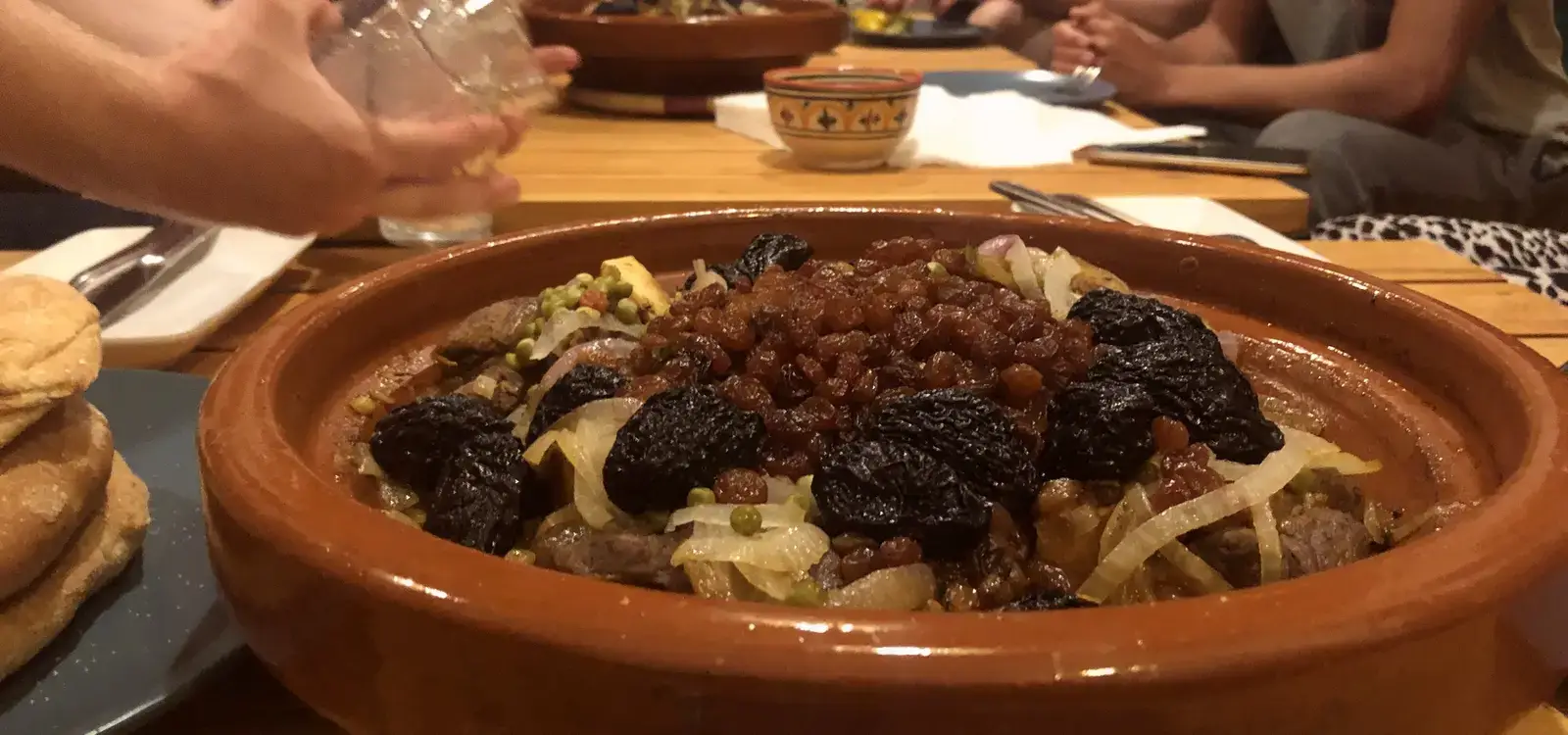
If there is one dish that has come to represent Morocco to the rest of the world, it is the tagine. Named after the beautiful conical clay pot in which it is both cooked and served, the tagine is a slow-cooked stew that brings together meat, vegetables, spices, and often fruits and nuts in a deeply aromatic and tender harmony that is unlike anything else in the world. The magic of the tagine lies in its method, the unique conical lid of the pot circulates steam continuously as it cooks, locking in moisture and allowing the flavors to deepen and develop over hours of slow, gentle heat. The result is a dish of extraordinary tenderness and complexity, meat that falls apart at the touch, vegetables that melt with flavor, and a rich, fragrant sauce that demands to be mopped up with warm, fresh bread.
The varieties of tagine across Morocco are seemingly endless: lamb with prunes and almonds, chicken with preserved lemon and olives, beef with vegetables and aromatic herbs, fish with chermoula and spiced tomatoes, and even vegetarian versions rich with chickpeas, root vegetables, and warming spices. Each region of Morocco has its own beloved version, its own local twist, its own secret spice combination passed down through generations of home cooks who know that the best tagine is always the one made with patience and love.
Couscous: The Soul of the Moroccan Table
Couscous is far more than just a dish in Morocco it is a ritual, a symbol, and a deeply communal act of togetherness. Made from tiny grains of steamed semolina wheat, couscous is widely considered to be Morocco’s national dish, and it holds a place of profound cultural significance in Moroccan life. Traditionally prepared every Friday the holy day of the week in the Islamic calendar couscous is a meal that brings entire families together around a single large plate, eating communally with their right hands in a spirit of warmth, generosity, and shared gratitude.
The preparation of couscous is a labor of love that can take hours. The grains must be rolled by hand, steamed multiple times over a bubbling stew until they are perfectly light and fluffy, then arranged beautifully on the serving dish and topped with the rich, fragrant meat and vegetable stew beneath. It is a dish that rewards patience and punishes shortcuts, and in the hands of an experienced Moroccan home cook, almost always a grandmother or mother, the result is one of the most deeply satisfying and nourishing meals that food has to offer.
Bastila: The Most Extraordinary Pie You Will Ever Taste
For those who have never encountered bastila, prepare to have your understanding of what food can be completely and joyfully overturned. Bastila is a traditional Moroccan pie that is as audacious and brilliant as Morocco itself, a dish that combines savory and sweet in a single, impossibly delicious creation. At its most traditional, it is made with slow-cooked pigeon meat, though chicken is now commonly used, layered between dozens of gossamer-thin sheets of warqa pastry, mixed with beaten eggs, fragrant spices, and a generous filling of ground almonds and cinnamon, then dusted with icing sugar and served as a starter at weddings, celebrations, and feasts. The bastila arrived in Morocco with the Moors from Andalusian Spain, and its extraordinary combination of flavors has made it one of the most celebrated and beloved dishes in the entire Moroccan culinary repertoire.
Harira: The Soup That Feeds the Soul
There are soups, and then there is harira. Morocco’s most beloved soup is a rich, hearty, deeply warming bowl of tomatoes, lentils, chickpeas, tender meat, vermicelli noodles, fresh herbs, and a symphony of spices that comes together in a way that feels like a warm embrace on a cold evening. Harira holds a special place in Moroccan culture as the soup traditionally served at the breaking of the fast during the holy month of Ramadan, the first taste of food after a long day of fasting, accompanied by sweet dates, warm milk, and traditional Moroccan pancakes. But harira is not just a Ramadan dish; it is a year-round comfort food, a staple of Moroccan homes and street food stalls alike, and one of those dishes that makes you feel, with the very first spoonful, that everything is going to be absolutely fine.
Zaalouk, Taktouka & the Art of the Moroccan Salad
One of the great unsung glories of Moroccan cuisine is its extraordinary range of salads, and in Morocco, a salad is nothing like what the rest of the world might expect. Moroccan salads are deeply flavorful, often cooked, and served warm or at room temperature as an appetizer alongside fresh bread at the start of a meal. Zaalouk is perhaps the most beloved, a smoky, silky combination of roasted eggplant and tomatoes, seasoned with garlic, cumin, and fresh herbs, with a depth of flavor that is entirely disproportionate to its simplicity. Taktouka, a specialty of the cities of Taza and Fez, combines roasted green peppers with tomatoes and spices in a dish that is bold, smoky, and completely irresistible. Together, these Moroccan salads represent some of the finest and most generous appetizers in the world, the kind that make you forget entirely that there is a main course on the way.
The Spices: The Secret Language of Moroccan Cooking
Ras El Hanout The King of Spice Blends
No discussion of Moroccan cuisine would be complete without paying proper tribute to its spices, the soul of everything that makes this food so extraordinary. At the heart of the Moroccan spice tradition is ras el hanout, a name that translates roughly as “top of the shop,” referring to the finest and most prized spices a vendor has to offer. Ras el hanout is a complex, deeply aromatic blend of up to 27 different spices, including cinnamon, cumin, coriander, ginger, turmeric, cardamom, mace, cloves, and many more, ground together in a combination that varies from spice merchant to spice merchant, from family to family, and from region to region. It is the heartbeat of countless Moroccan dishes, and no two blends are ever exactly the same.
Saffron, Preserved Lemons & the Pantry of Morocco
Beyond ras el hanout, the Moroccan spice pantry is a world of extraordinary flavor. Saffron from the fields of Talaouine, considered among the finest in the world, gives dishes like chicken tagine and Moroccan rice their unmistakable golden warmth. Preserved lemons, with their intense, fermented citrus flavor, add a depth and brightness to tagines and salads that no fresh lemon can replicate. Argan oil, cold-pressed from the nuts of the ancient argan tree that grows only in the southwest of Morocco, adds a rich, nutty warmth to both savory dishes and sweet preparations like the magnificent amlou paste. These are the building blocks of a cuisine that has spent thousands of years perfecting the art of flavor.
The Culture of Eating: Food as Love, Community & Ritual
The Communal Table: Eating Together as an Act of Grace
One of the most beautiful things about Moroccan food culture is not what is on the plate, but how it is shared. In Morocco, eating is never a solitary act; it is a communal ritual, an expression of love and hospitality, and a deeply social ceremony that brings people together in the most fundamental and human way imaginable. Traditionally, Moroccan families gather around a low round table, sitting on cushions on the floor, eating from a single shared plate with their right hands, using pieces of fresh bread to scoop up sauces and carry food to the mouth. Before the meal begins, warm damp towels are passed around so that everyone’s hands are clean, a small but deeply thoughtful gesture of care and welcome. The meal begins when the head of the family says “bismillah” in the name of God, and the feast begins with a spirit of gratitude and togetherness that is genuinely moving to witness.
Mint Tea: Morocco's Liquid Hospitality
If Moroccan food is a language, then mint tea is its most frequently spoken word. Made from green gunpowder tea, a generous handful of fresh spearmint, and plenty of sugar, Moroccan mint tea, known as atay, is so much more than a beverage. It is a symbol of welcome, a gesture of friendship, an invitation to slow down and be present. Traditionally served in a silver teapot on an ornate tray, the tea is poured from a great height into small decorated glasses. The pouring technique is as important as the tea itself, creating a frothy top that is considered the mark of a perfectly prepared glass. It is enjoyed morning, noon, and evening before meals, after meals, during conversations, and at every moment of genuine human connection in between. To be offered mint tea in Morocco is to be told, without words, that you are welcome here.
Sweet Morocco: Pastries, Desserts & the Art of Indulgence
Kaab El Ghzal & the World of Moroccan Pastry
Moroccan sweets and pastries are a world unto themselves, a testament to the Andalusian and Arab influences that have shaped the country’s culinary identity over centuries. Kaab el ghzal, meaning “gazelle ankles,” are perhaps the most iconic, delicate crescent-shaped pastries filled with fragrant almond paste and orange blossom water, their tender shells dusted lightly with icing sugar. Chebakia, particularly beloved during Ramadan, are beautiful flower-shaped pastries made from fried dough, soaked in honey, and sprinkled with sesame seeds. Briouats, small, flaky pastry parcels filled with almond paste or savory meat, bridge the gap between sweet and savory in a way that is entirely and wonderfully Moroccan. And amlou, the extraordinary paste of roasted almonds, argan oil, and honey, eaten with warm bread for breakfast, is one of the most uniquely Moroccan flavors in existence, a spoonful of pure, golden joy.